CatholicGo
LiveDirectory and community for Catholic pilgrimage sites across the United States
Visit CatholicGo →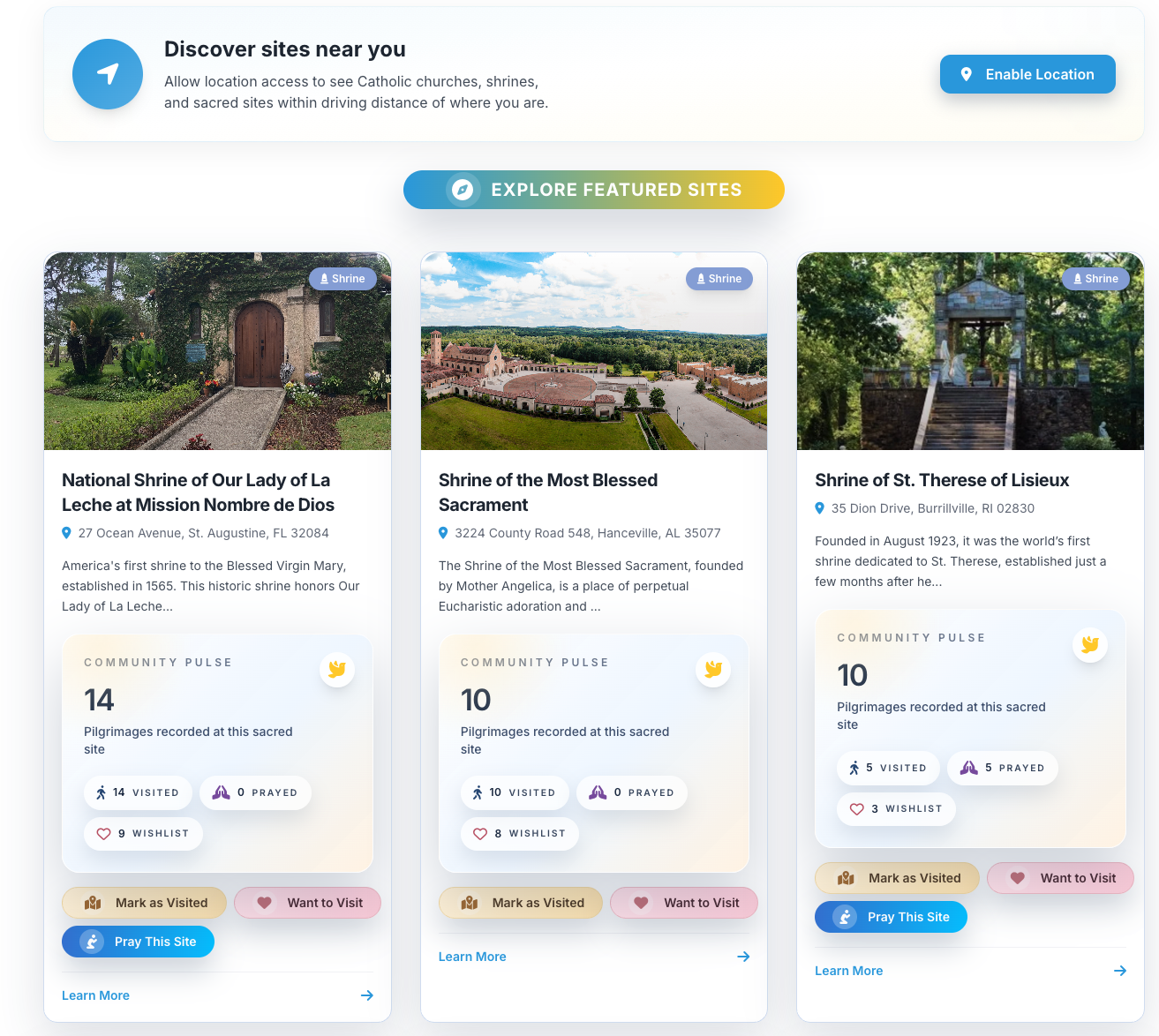
TLDR
Built on Supabase with a custom admin dashboard. Grew to 10K+ sessions with 15% visitor-to-account conversion. The key insight: directories are commodities—community and personalization create retention.
The Problem
My sister and brother-in-law came to me with an observation: there are hundreds of beautiful, historically significant Catholic sites throughout the United States—monasteries, shrines, basilicas, grottos—that most people have never heard of. They discovered this firsthand on a trip to Rhode Island, stumbling upon a small monastery they didn't know existed and making an impromptu pilgrimage.
These sites often struggle financially because of low visibility. People drive past them every day without knowing they're there. Meanwhile, Catholics who would love to visit these places have no easy way to discover them—especially the hidden gems that might be in their own backyard.
There's no comprehensive directory that brings all these sites together in one place, with enough detail to actually plan a visit.
Google Maps shows you where things are, but it doesn't tell you the story, the history, or why a particular site matters.
The Bet
What if we could build a directory that not only cataloged these sites but actively drove traffic to them? Not just a list, but a platform that makes discovery easy and pilgrimages accessible—helping people find meaningful sites nearby, learn about them, and actually visit.
The hypothesis: if we can build awareness of these sites, it will encourage people to make pilgrimages and drive physical traffic.
We validated the idea by talking to friends, family, and colleagues in the Catholic community. The response was consistently enthusiastic—people immediately understood the value and wanted to use it.
Building It
I saw this as an opportunity to both prepare for real traffic and expand my technical skill set. The first version was deliberately simple—a basic directory with a SQL database. But as we prepared for our soft launch in September, I rebuilt the platform with proper infrastructure that could scale.
Phase I: The Directory
The core product: a searchable directory of Catholic sites across the United States. Each site has its own page with photos, description, location, and visiting information. The homepage features a Discover section highlighting notable sites, plus an interactive map showing all 270+ sites with pins across the country.
Phase II: User Accounts & Community
Users can create accounts and mark sites as "Visited," "Want to Visit," or make a "Virtual Pilgrimage." We added prayers associated with each site—so someone who can't make the physical journey can still connect spiritually.
The account system introduced a pilgrimage passport: track where you've been, earn stamps, see your journey. This transformed CatholicGo from a directory into a personal pilgrimage tracker.
Phase III: Localized Discovery
Users can share their location to see sites nearby. This was crucial for top-of-funnel conversion—showing someone that there's a beautiful shrine 20 minutes from their house is way more compelling than browsing a national directory. We surface sites in radius tiers based on proximity and density.
What's Next: Collections & Badges
We're building a Strava-like gamification layer: collections of sites, achievement badges, ways to track and share your pilgrimage journey with family and friends. The goal is making pilgrimage social and rewarding—not in a gimmicky way, but in a way that genuinely encourages people to visit more sites.
Technical Decisions
Supabase Backend
I migrated from a simple SQL database to Supabase as we prepared for launch. It handles authentication, database, and real-time features. The architecture needed to support user accounts, site management, and eventually social features—Supabase gave us room to grow.
Cloudflare Proxy
All traffic routes through Cloudflare to block bots and protect the site. This was a new technical challenge for me—learning to configure edge security, handle caching, and ensure legitimate users get through while bad actors don't.
Admin Dashboard
I built a full admin interface so my sister Darice can manage the site without touching code. She can add new sites, upload photos, mark sites as featured, and manage the entire directory. The dashboard also handles user-submitted content: a contact form feeds messages directly to Darice for response, and testimonials from site visitors flow into an approval queue before appearing on the site. This was critical—I didn't want to be a bottleneck for content updates or community management.
Web-First, No Mobile Apps (Yet)
We deliberately chose not to build iOS and Android apps. Mobile is double the work, and we wanted to validate the concept and build out features on web first. The goal is 10,000 users before we invest in native apps.
The web-first approach let us iterate quickly on features like localized discovery and user accounts. We shipped three major phases in months rather than getting stuck in mobile development cycles.
Traction
CatholicGo has grown to 10,000+ sessions. But the metrics that matter most are engagement and conversion:
- 15% of visitors create accounts
- 20% of account holders mark sites as "Want to Visit"
- Power users have marked 10+ sites, building real pilgrimage plans
- 270+ sites cataloged across the United States
Beyond the numbers, we're having ongoing conversations with users who express genuine joy that this tool exists. People are discovering sites they never knew about—sometimes minutes from where they live.
Distribution Strategy
Content marketing on Instagram and TikTok has been our primary growth channel. We create posts highlighting individual sites, their history, and why they're worth visiting. Catholic influencers with 150,000+ followers have been liking and resharing our content, which drives traffic back to CatholicGo.
After our soft launch, we were featured in Aleteia, eCatholic, and Catholic Faith Network—validation that the concept resonated beyond our immediate network.
What I Learned
Community > Directory
Anyone can build a list of Catholic sites. The value isn't the directory—it's the community around it. User accounts, pilgrimage tracking, and eventually reviews and testimonials transform CatholicGo from a reference tool into something people return to.
We're building TripAdvisor for Catholic pilgrimage, not just Google Maps with pins.
Localization Converts
Personalization drives conversion. Abstract directories feel overwhelming. "There's a beautiful shrine 15 minutes from your house" is compelling and actionable. Meet users where they are—literally.
Build for Delegation
The admin dashboard was one of the best investments. I'm not the domain expert on Catholic sites—my sister is. Giving her tools to manage content meant the site could grow without me being involved in every update. Build systems that let the right people do the work.
Start Web, Earn Mobile
The temptation to build mobile apps immediately is strong. Resisting it let us ship faster, learn more, and build confidence in the concept. Mobile apps are a reward for proving product-market fit, not a prerequisite for it.